.png)
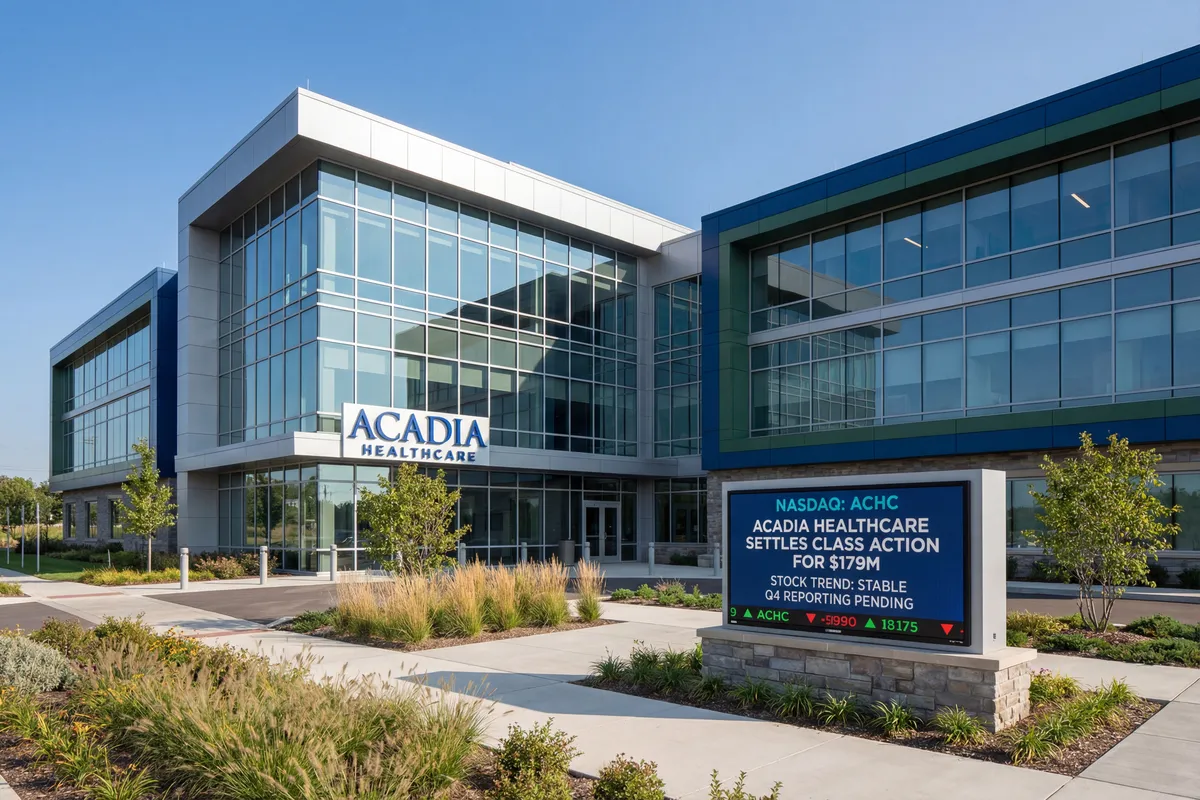

Update: The settlement was granted final approval on April 29, 2026.
Investors who purchased or otherwise acquired Acadia Healthcare Co. Inc. common stock between April 30, 2014, and Nov. 15, 2018, may be eligible to claim a cash payment from a class action settlement.
Acadia Healthcare Co. Inc. and individual defendants agreed to pay $179 million to settle a class action lawsuit alleging they violated federal securities laws by making materially false or misleading statements about the quality of care, staffing and regulatory compliance at its facilities and the expected financial performance of its United Kingdom operations.
Who can file a claim?
The settlement class includes anyone who purchased or otherwise acquired Acadia Healthcare Co. Inc. common stock between April 30, 2014, and Nov. 15, 2018, inclusive.
Additional details
- Both individuals and entities can be class members.
- Each separate legal entity must submit a separate claim.
- All joint purchasers or acquirers must sign the claim form.
- Executors, administrators, guardians, conservators and trustees may submit claims on behalf of others but must provide documentation proving their authority.
How much can class members get?
The total settlement fund is $179,000,000. The amount each class member will receive depends on several factors:
- The number of valid claims submitted
- The number of shares purchased or acquired during the class period
- The timing of each purchase, acquisition and sale
- The total recognized losses of all claimants
The settlement administrator will distribute payments on a pro rata basis according to the court-approved plan of allocation.
- The estimated average distribution per allegedly damaged share is $2.03 before deductions for taxes, notice and administration costs, and attorneys' fees and expenses.
- Actual payments may be higher or lower depending on individual claims and the total number of valid claims.
- The settlement administrator will calculate each class member's payment based on the recognized loss amount assigned to each transaction.
- Recognized loss amounts depend on purchase and sale timing. The settlement administrator will calculate them using the court-approved plan of allocation, which applies different formulas depending on when class members purchased, held or sold shares.
- For shares sold during the class period, the recognized loss per share is the lesser of the inflation per share at the time of purchase minus the inflation per share at the time of sale or the difference between the purchase price and the sale price.
- For shares held through the end of the class period and sold by Feb. 13, 2019, the recognized loss per share is the least of the inflation per share at the time of purchase, the difference between the purchase price and the sale price or the difference between the purchase price and the average closing price up to the date of sale.
- For shares held through Feb. 13, 2019, or sold after that date, the recognized loss per share is the lesser of the inflation per share at the time of purchase or the difference between the purchase price and $28.83 (the average closing price during the 90-day look-back period).
- If a recognized loss calculates to a negative number or zero, the recognized loss will be $0.
- The settlement administrator will match purchases and sales on a first-in, first-out basis.
- Class members must have a net overall loss on transactions during the class period to be eligible for a distribution.
- If total recognized losses exceed the net settlement fund, the settlement administrator will reduce payments on a pro rata basis.
- Class members whose payment would be less than $10 will not receive a payout.
How to claim an Acadia Healthcare securities class action settlement payment
Class members may file a claim online or download, print and complete the PDF claim form and mail it to the settlement administrator. The deadline to file a claim is April 30, 2026.
Settlement administrator's mailing address: Acadia Healthcare Securities Litigation, Claims Administrator, c/o Verita Global, P.O. Box 301135, Los Angeles, CA 90030-1135
Proof or documentation required to submit a claim
All class members must provide the last four digits of their Social Security number or their full taxpayer identification number. They must also provide purchase, acquisition and sale information, including:
- Number of shares of Acadia common stock held at the close of trading on April 29, 2014
- Purchases and acquisitions of Acadia common stock between April 30, 2014, and Feb. 13, 2019
- Sales of Acadia common stock between April 30, 2014, and Feb. 13, 2019
- Number of shares held at the close of trading on Nov. 15, 2018
- Number of shares held at the close of trading on Feb. 13, 2019
Claimants must provide documentation supporting their transactions. Acceptable proof includes:
- Broker confirmation slips
- Broker account statements
- Other documentation of purchases, sales and holdings during the relevant period
Payout options
- Paper check
- Electronic payment
$179 million settlement fund
The $179,000,000 settlement fund includes:
- Settlement administration costs: To be determined
- Attorneys' fees: Up to $59,666,667
- Attorneys' expenses: Up to $5,500,000
- Service awards to class representatives: Up to $65,000 total
- Payments to eligible class members: Remainder of the fund
Important dates
- Fairness hearing: April 29, 2026
- Deadline to file a claim: April 30, 2026
When is the Acadia Healthcare securities class action settlement payout date?
The settlement administrator will issue payments to eligible class members after the court resolves any appeals and grants final approval of the settlement.
Why did this class action settlement happen?
The class action lawsuit alleged Acadia Healthcare Co. Inc. and certain executives violated federal securities laws by making materially false or misleading statements about the quality of care, staffing and regulatory compliance at its facilities and the expected financial performance of its United Kingdom operations. The plaintiffs claimed these statements caused Acadia common stock to trade at artificially inflated prices during the class period, resulting in investor losses.
Defendants denied all allegations of wrongdoing but agreed to settle to avoid the costs, risks and delays of continued litigation.

.webp)
.webp)
.webp)

.webp)
.webp)
.webp)
.webp)






.svg)