.png)
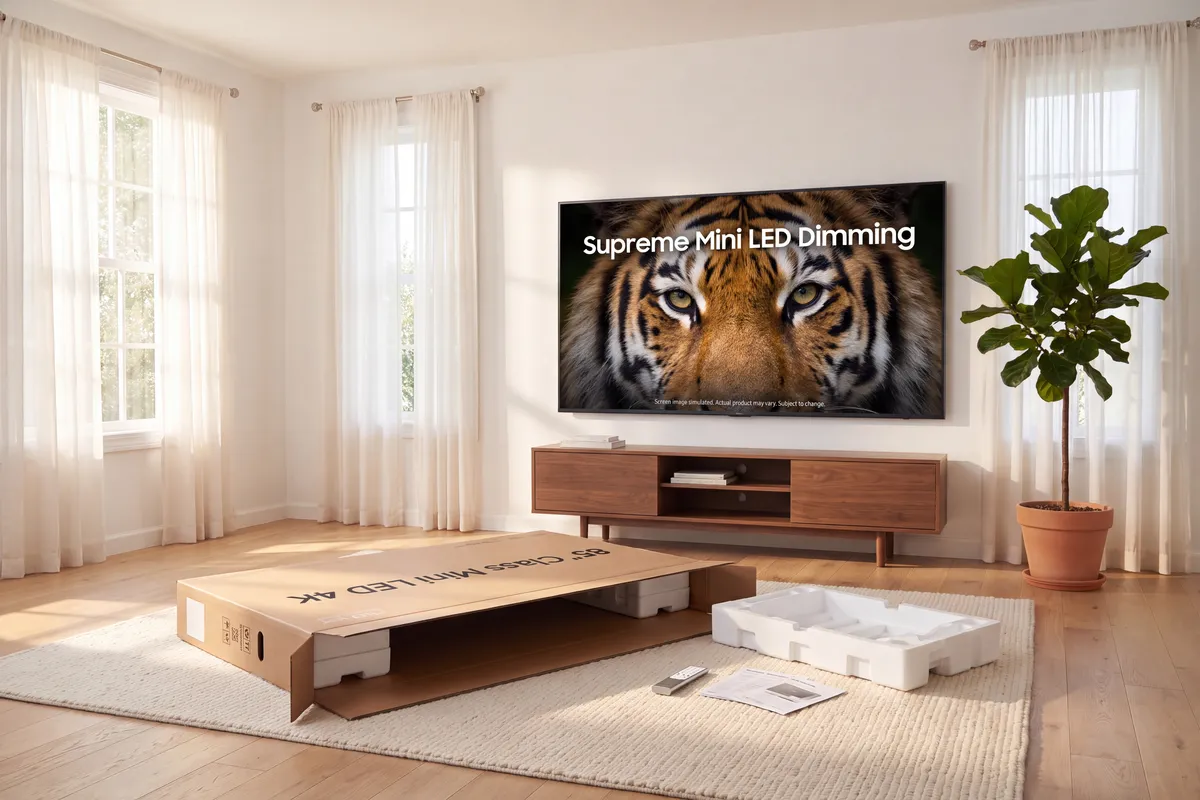

Ruben Flores filed a class action lawsuit against Samsung Electronics America Inc. on Sept. 22, 2026, in the U.S. District Court for the District of New Jersey.
The lawsuit alleges Samsung markets its 2026 M70H, M80H and M90H televisions as mini LED TVs when they contain ordinary LED backlights with no local dimming.
What is a mini LED TV?
Mini LED TVs contain hundreds or thousands of tiny LEDs, typically 0.1 to 0.3 millimeters wide, grouped into zones the TV can brighten or dim, the lawsuit claims. That feature, called local dimming, allows the TV to light up a bright object while keeping the dark area around it black.
The allegations
The complaint notes that each Samsung M series model has mini LED in its name and that the company's product pages describe many tiny LEDs working together to provide "brighter visuals with richer contrast."
The complaint alleges the M70H, M80H and M90H use the same backlight as Samsung's entry-level crystal UHD line: two strips of standard-size LEDs measuring about 0.5 millimeters each. The set reportedly has no circuitry to control separate zones so all its LEDs brighten and dim together.
The complaint cites independent testing lab RTINGS, which bought both the M70H and the M80H and found neither contained local dimming. The lawsuit also cites a TechRadar test in which the M80H reached less than a quarter of the peak HDR brightness of the QN80H, a Samsung set with mini LED local dimming.
Flores says he paid $999.99 for an 85-inch M70H and would not have paid that much had the company described its backlight accurately.
Samsung's reported fine-print disclaimer
Beneath large type promising supreme mini LED dimming, one M70H ad displays a single small line reading, "Supreme mini LED dimming is software-based (not full-array hardware-based) technology." The lawsuit alleges that text is an admission that the company knew the sets lacked mini LED hardware because software cannot create lighting zones a backlight does not have.
Samsung's 85-inch QN80H, which has a full-array mini LED backlight, sells for $3,299.99. The complaint claims the shared label makes the $999.99 M70H look like a mini LED bargain.
Legal claims in the Samsung lawsuit
The suit brings seven claims. Four cover a nationwide class, and three cover a California subclass:
- Fraudulent misrepresentation and concealment, which targets knowingly false statements and hidden facts
- Negligent misrepresentation, which targets careless false statements
- Breach of express warranty, which covers broken product promises
- Unjust enrichment and restitution, which covers unfair profits at buyers' expense
- California Consumers Legal Remedies Act, which bans deceptive practices in consumer sales
- California False Advertising Law, which bans misleading advertising
- California Unfair Competition Law, which bans unlawful, unfair or fraudulent business practices
Flores seeks compensatory damages, restitution, punitive damages on the fraud claim and attorneys' fees along with an order barring Samsung from calling the M series mini LED and requiring corrective disclosures.
What the lawsuit means for M Series buyers
The proposed nationwide class covers anyone in the United States who bought a new M70H, M80H or M90H television from Jan. 1, 2026, to the present, and the subclass covers people who bought one in California.
As of this writing, there is no settlement, no claims process and no money available.



.webp)
.webp)
.webp)

.webp)
.webp)
.webp)
.webp)




.svg)